

For a while, the business side of LetPeopleWork ran on a Miro board.
Our Obeya. Cards, connections, leads becoming customers, decisions, themes. A big visual room where we could see everything at once. And it served us well. This is not a story about a board that failed.
It’s a story about a question that kept nagging us as more and more of our work started involving AI: our Obeya was built for us. Visual, spatial, human-friendly. But the agents we increasingly work with can’t read a Miro board. All that context, our pipeline, our decisions, our priorities, was locked in a format only humans could use. So we asked ourselves a very Obeya kind of question: how do we make the state of our company visible not just to us, but to everything we work with?
The answer became something we call obAIa. Everything lives as plain Markdown files in a Git repo, and we work with it through Claude Code, typing, not clicking. If words like Git, Markdown, and Claude Code just made you slightly nervous, stay with me. That nervousness is part of this story, and I’ll come back to it at the end.
First, a confession
I need to be upfront about something: I almost didn’t use this thing.
When Benji first set it up, my quiet reaction was “this is for you, not for me.”
Because obAIa lives in a repo, which, to my non-coder eyes, looked an awful lot like a developer thing. No friendly buttons, no colorful board. I can use it with Claude Code (not the terminal guy yet): A window where you type, sitting on top of the repo.
For someone who has spent his whole career saying “I’m not a coder,” that’s exactly the kind of environment that whispers you don’t belong here.
I’ve written before about slowly discovering that I can build things without understanding what’s happening under the hood. But this felt like a different league. A league I wasn’t in.
Turns out, yes, even I can do it. And what surprised me most is how little of the scary stuff I ever actually touch. Claude Code turned out not to be a developer tool that tolerates me. It’s a conversation that happens to have a company attached. I type thoughts in my own words. I ask for views. I run a command when we face a decision. That’s the whole “coding.” It’s the most patient colleague I’ve ever had, one that never rolls its eyes when I phrase something clumsily.
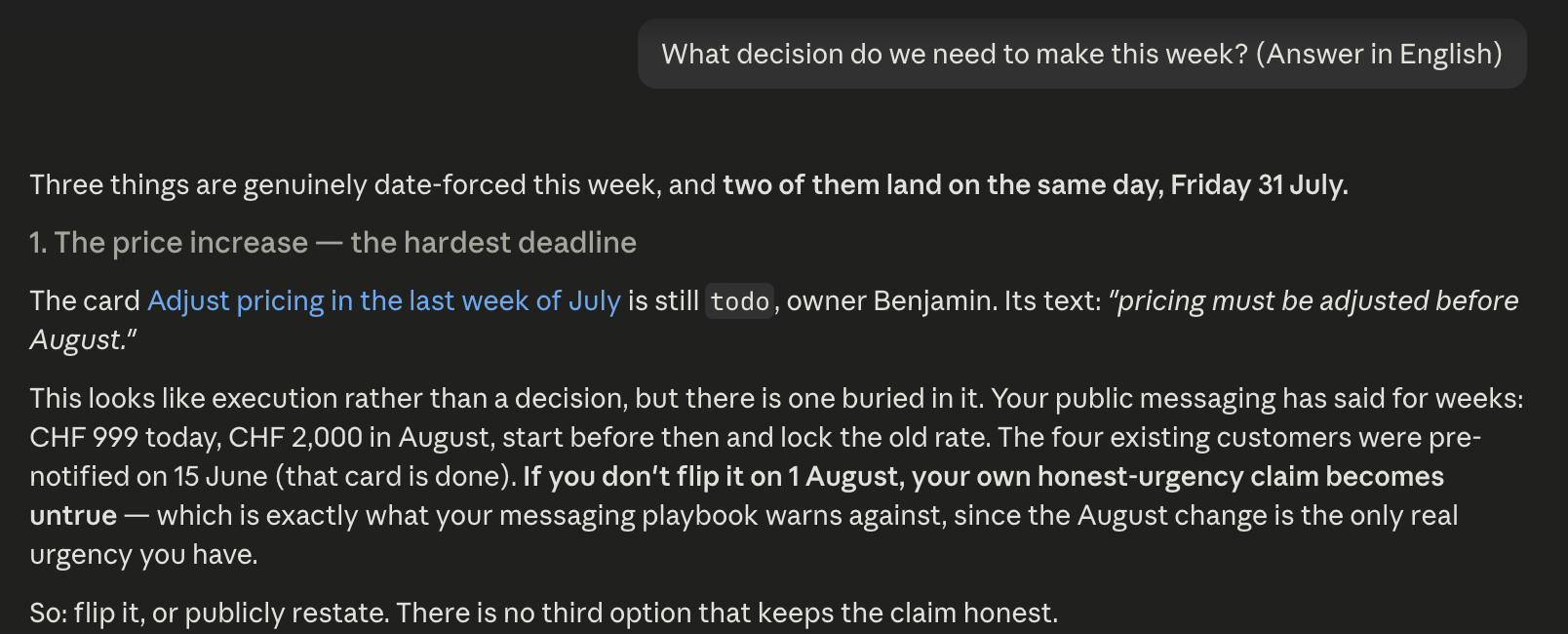
The core idea: records instead of board maintenance
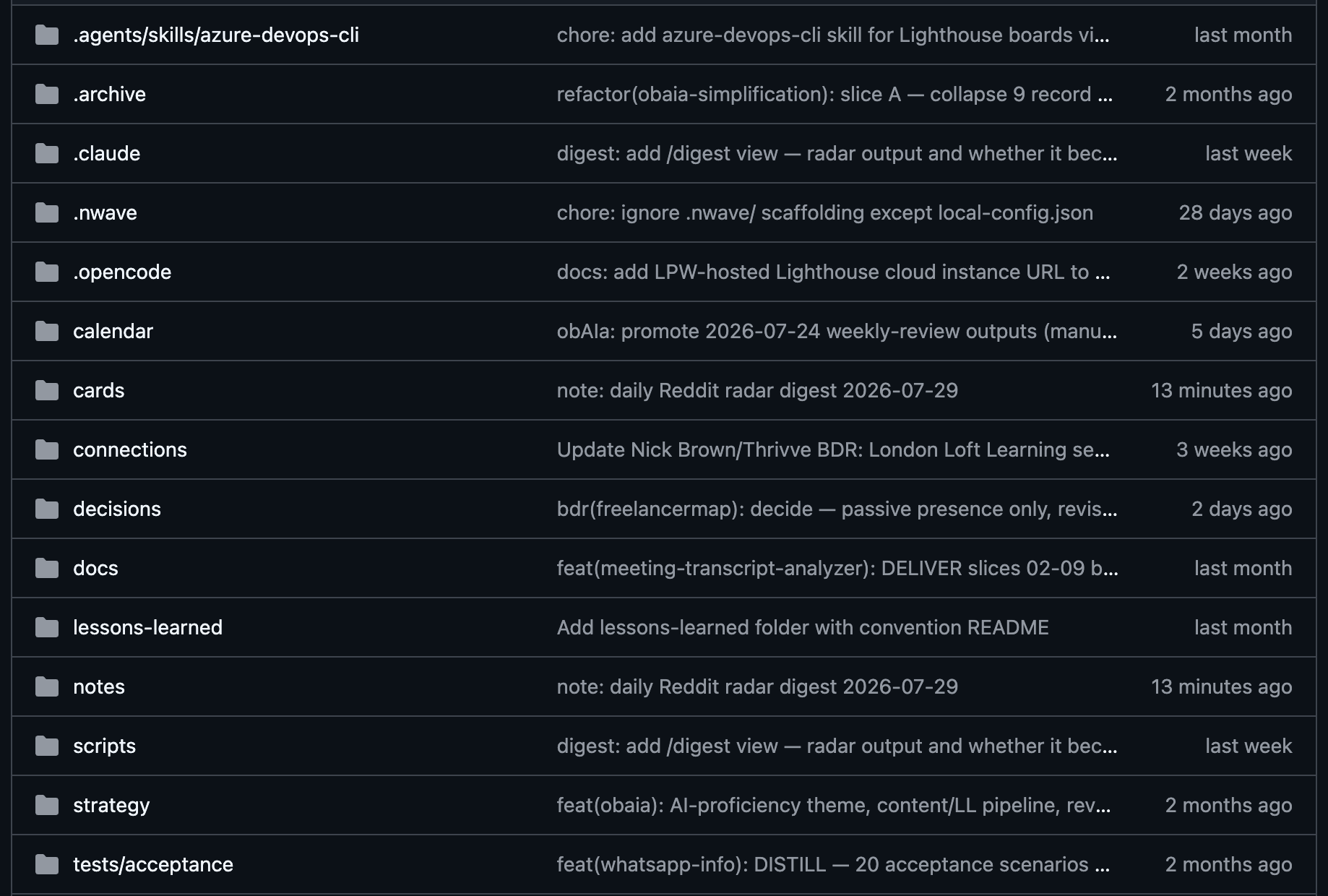
The heart of it is almost offensively simple: everything is a plain text record.
Decisions, cards, contacts, dates, notes, themes. All simple files, versioned, searchable, ours forever. No tool, no database, no SaaS subscription.
And here’s the part that changes everything: the views are computed from those records instead of being maintained. Our board isn’t a surface someone has to keep current. It’s a calculation, generated fresh from the records every time we open it. That’s why it can’t go stale. There’s simply nothing left that could.
It’s the same idea that sits underneath Lighthouse. We don’t maintain status reports, we look at what the data says. We’ve just pointed the principle at ourselves.
There’s a second, quieter superpower in this setup: because everything is just plain text, everything is compatible with everything. We can attach new automations, new agents, new views, new integrations, without migrations or plugins or export buttons. Plain text is the most connectable format ever invented. Whatever we dream up next, it will be able to read what’s already there.
What’s in there
Six lanes:
In decisions/ live our BDRs, Business Decision Records. Thirty of them by now. Every meaningful decision gets captured while we’re making it: the question, the options, what we decided, and a date when we’ll look at it again. More on that in a moment, because it’s the heart of the whole thing.
In cards/ lives committed work, our board items.
In connections/ live the relationships in our pipeline: lead becomes trial becomes customer. Or doesn’t, and we capture that too.
In calendar/ lives everything with a date attached: meetups, talks, vacations, and, very usefully, expiring trial licenses.
Plus notes/ for half-baked thinking, and themes/ for our Now, Next, Later.
To make this concrete, here’s what a BDR looks like (details simplified for this post):
BDR: Should we apply to speak at DevFest 2026 in Prague?
Context: CFP deadline in 6 days. Developer audience, not our typical crowd. We'd self-fund the travel.
Options: Don't apply, spend the time on our pipeline instead / Apply with an AI-agents talk as a brand play, commit travel only if accepted / Apply, but pre-decide to decline the slot if one of us can't make it / Skip it and target an event where the audience actually matches who we serve.
Perspectives: Ran it through all three lenses. Marketing and Commercial said no (audience-fit gap, opportunity cost against our revenue target). Social said conditional yes (brand and content value). Split 2:1, and the disagreement was purely about weighing near-term pipeline against longer-term brand, not about the facts.
Decision: Declined. We didn't apply.
Revisit: Pending. We'll check whether skipping it was right.
What I love about this one: the three perspectives disagreed 2:1, and the record captures exactly where the disagreement lived. Not in the facts, everyone agreed on those, but in how to weigh them. That's the kind of nuance that would normally evaporate the moment the conversation ends.
Now it's written down, waiting for us to find out who was right.
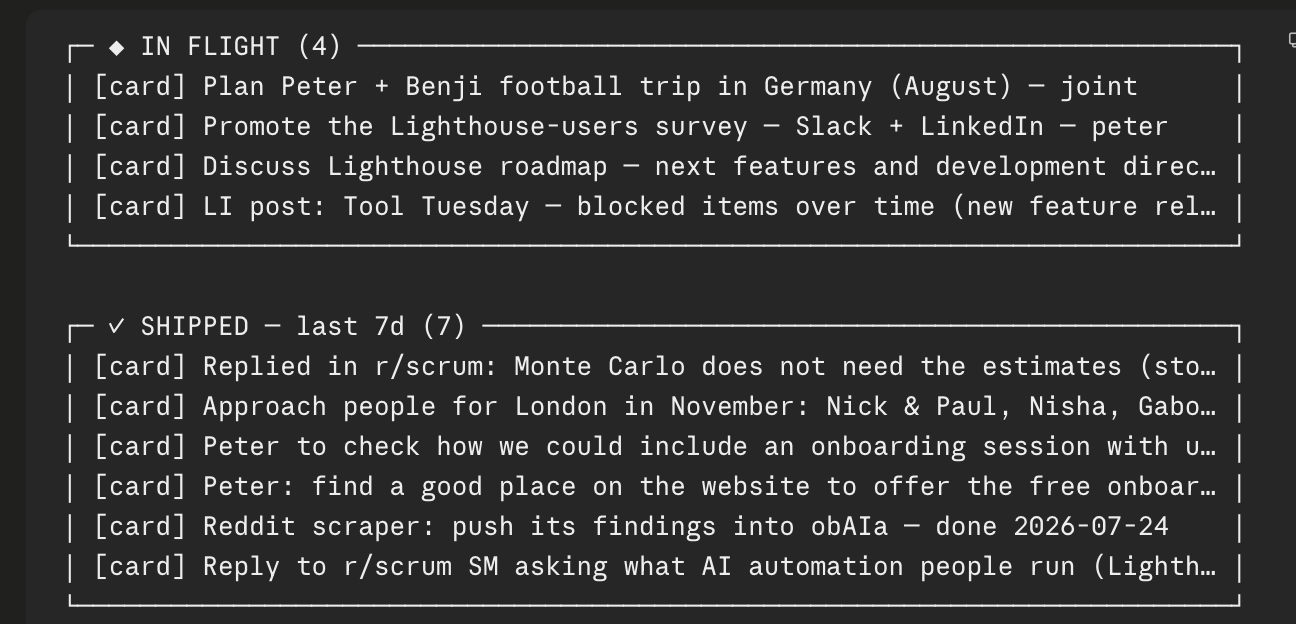
The views: look at them, don’t update them
On top of these records sit views we just call up. Read-only. Nothing to maintain.
/board shows everything in flow at a glance. That’s what replaced our Miro.
/pipeline shows the funnel, including flags for contacts that have gone quiet for too long and trials about to expire. We don’t forget anyone anymore, because the system remembers for us.
/trends shows revenue pace, conversion, momentum, and open loops. The questions you ask yourself as a founder at night, answered from real records instead of gut feeling.
/agenda builds us a workable script for our sync. We no longer start with “so, what’s up?”, we start with a list generated from the actual state of things. And it helps us even when we meet in person: usually one of us posts the agenda to WhatsApp beforehand, or we just pull it up on our laptops and work through it together.
Capturing without thinking
The most important habit in daily use is the most unassuming one: I just type a thought.
Exactly as it comes. Half-formed, unsorted, between two meetings. The system figures out on its own which lane it belongs to and proposes the finished record. Nothing gets written until I confirm.
That sounds like a small thing. It’s the reason the system is filled at all. The barrier to capturing something is practically zero. And a system that everything flows into is a system you can trust.
Deciding with three perspectives we don’t have on the payroll
Now to the heart of it.
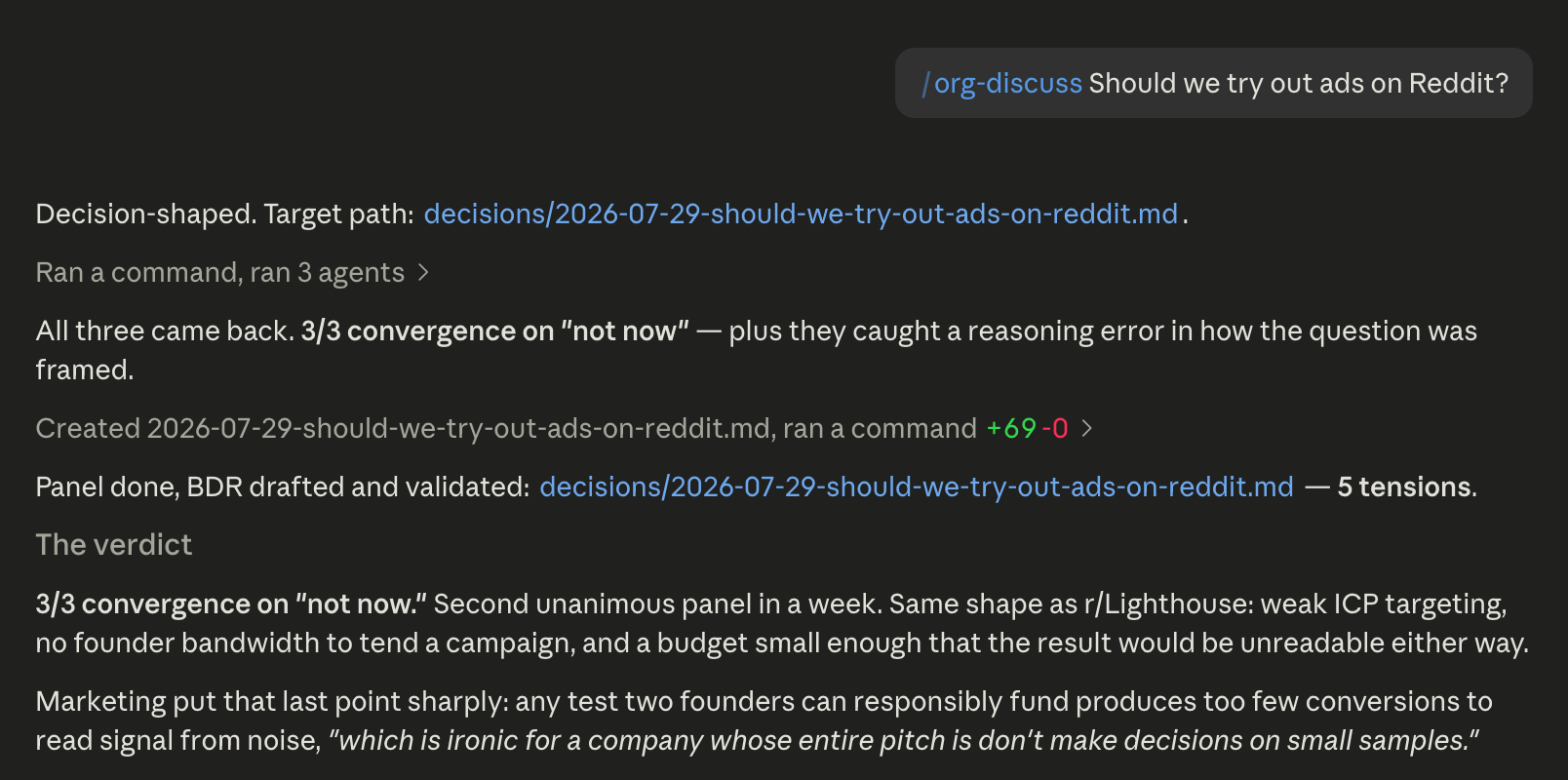
When a real decision comes up, we no longer just ask each other what we think. We run /org-discuss. Three agents answer independently: a marketing perspective, a social perspective, a commercial perspective. Then the tensions between the three views get worked out, and where they contradict each other is usually where the actual decision lives. At the end, a BDR draft falls out.
And then, this matters, we decide. Not the system. It makes visible the angles that two people would otherwise miss. The decision stays with us.
/org-decisions-list shows us the full decision corpus. And /org-decisions-revisit closes the loop: what actually happened? Did the decision deliver what we promised ourselves?
That’s the most uncomfortable and most valuable command of all. Most companies make decisions and never look back, especially at the bad ones. We can’t look away anymore. It’s right there, in our own words, with a date on it. It’s exactly what we’ve been telling teams about their delivery for years: look at what actually happened, not at what you planned. Now it applies to us too.
And then it works while we don’t
A few things run entirely without us now.
Every two days, a Reddit radar runs. It harvests relevant discussions, writes a digest, and, this is the interesting part, promotes at most one thing into an actual card. Not ten. One. After seven days, digests move to the archive. The radar has already created cards on its own. So we have a team member who reads Reddit so we don’t have to, and who is disciplined enough not to bury us in noise.
And trial licenses for Lighthouse are generated with a single command via a GitHub Action, recorded directly on the relevant connection. What used to be a manual routine of copying and noting things down is now one step.
Knowledge that gets loaded instead of guessed
The system doesn’t guess who we are. It loads it.
Lighthouse product knowledge, our consulting catalogue, both of our profiles, testimonials, the 2026 strategy, our LinkedIn tactics, and our messaging rules, for example: no invented numbers, ever. So when we discuss a post or an offer, the system argues from what we actually offer and what we actually stand for, not from generic marketing speak.
This was the original itch, remember: all that knowledge used to live in a visual board only we could read. Now it lives where both we and our agents can use it. Obeya, applied to the Obeya.
What deliberately stays out
One point matters to us, precisely because we stand for openness everywhere else.
Alongside obAIa there’s LetPeopleAlign, our setup for meetings. Five agents that turn conversations into grounded notes: analyze, extract decisions, detect drift, suggest improvements, prep the next conversation. That stays local. It never lands in the repo, and it never gets committed. Conversations with people are something different from pipeline records, and we draw that line deliberately.
Why I’m telling you this
Not because obAIa is a product. It isn’t, and it’s not planned to become one.
I’m telling you because there’s a stance behind it that’s bigger than the tool: Make the state visible. Decide continuously instead of once a quarter. Look back and check whether reality agreed with you. And don’t maintain artifacts that can go stale, compute them from what’s actually there.
That’s exactly the mindset we bring into delivery organizations with Lighthouse. We’ve just applied it to ourselves. And frankly, it would be strange to tell teams to stop doing planning theater while running our own company off a board nobody fully trusts.
But there’s a second reason, and it might be the bigger one.
obAIa has quietly changed what we think AI actually is.
The common story about AI is that it’s a tool. You have a task, you point the tool at it, you get a result faster. Write this email. Summarize this document. Useful, sure. But that framing sells it short, and obAIa is our daily proof of why.
Because obAIa doesn’t just execute tasks for us. It holds context we would otherwise lose. It remembers decisions we would otherwise forget. It watches Reddit while we sleep and shows discipline about what deserves our attention. It brings three professional perspectives into a two-person room. It nudges us, on a date we set ourselves, to face whether a past decision actually worked. No tool in the traditional sense does any of that. A hammer doesn’t remind you which nails you regretted.
What we actually have is closer to a colleague. One with a perfect memory, no ego (even though not so sure about this one when considering the feedback it provides from time to time), infinite patience, and zero interest in office politics. It doesn’t replace either of us. It doesn’t make our decisions. But it extends us in exactly the places where two humans running a company are structurally weak: memory, consistency, and the discipline to follow up on our own intentions.
And the efficiency gain is real, but it’s not the kind people usually imagine. It’s not “we do the same things faster.” It’s that whole categories of work simply disappeared. Nobody updates a board anymore, the board computes itself. Nobody prepares the sync agenda, it’s generated. Nobody keeps a mental list of trials about to expire, the system flags them. Nobody tries to remember why we made that call in March, it’s written down, in our own words, with a revisit date attached. The time we used to spend keeping our company’s state in our heads now goes into actually running the company.
That’s what I mean when I say AI is more than a tool. A tool makes a task faster. This changed which tasks exist.
One last thing, about those scary words
Remember the beginning? Git, Markdown, Claude Code. The words that made me almost not use this thing.
Here’s what I want you to notice: I haven’t mentioned any of them since the introduction. Not because I was hiding them. Because they stopped mattering. In months of daily use, I have never written a line of code, never resolved a merge conflict, never done anything that felt like the developer league I thought I wasn’t in. I type thoughts. I ask questions. I make decisions. The technical machinery is there, somewhere underneath, handled.
That’s the quiet lesson I’d offer anyone who feels that same nervousness: the intimidating words at the entrance are not a description of what daily life inside is like. If you’re not afraid of them, or if you walk in despite being afraid, you may find you never have to deal with them at all.
Two founders, plain text records, and a system that thinks along without taking the decisions away from us. That’s all it is. But it has changed how we work, and along the way, it changed what we believe working with AI can look like.
Let’s try.
P.S. The biggest difference from the Miro board isn’t the technology. It’s a feeling. With the board, I always carried this quiet worry that somewhere a card was hanging that no longer told the truth. That worry is gone. Not because we got tidier, but because there’s nothing left that could hang there wrong. The best maintenance is the kind you’ve abolished.
Want to see how we work, live? We’ll be running a meetup soon about the way we work at LetPeopleWork, obAIa included. Keep an eye on our Lighthouse Live group so you don’t miss it.
If the mindset behind this resonates, making state visible, deciding continuously, revisiting decisions against reality, that’s exactly what we help delivery organizations do at LetPeopleWork. Our free and open-source tool Lighthouse brings the same thinking to your delivery data: flow metrics and probabilistic forecasts, self-hosted, straight from your Jira, Azure DevOps, or Linear. And if you’re curious where your own delivery stands, our free Delivery Predictability Assessment gives you a clear read in five minutes, no email required.